Physical Address
34 Ire-Akari Estate Road, Isaga Tedo, Lagos, Nigeria
Physical Address
34 Ire-Akari Estate Road, Isaga Tedo, Lagos, Nigeria

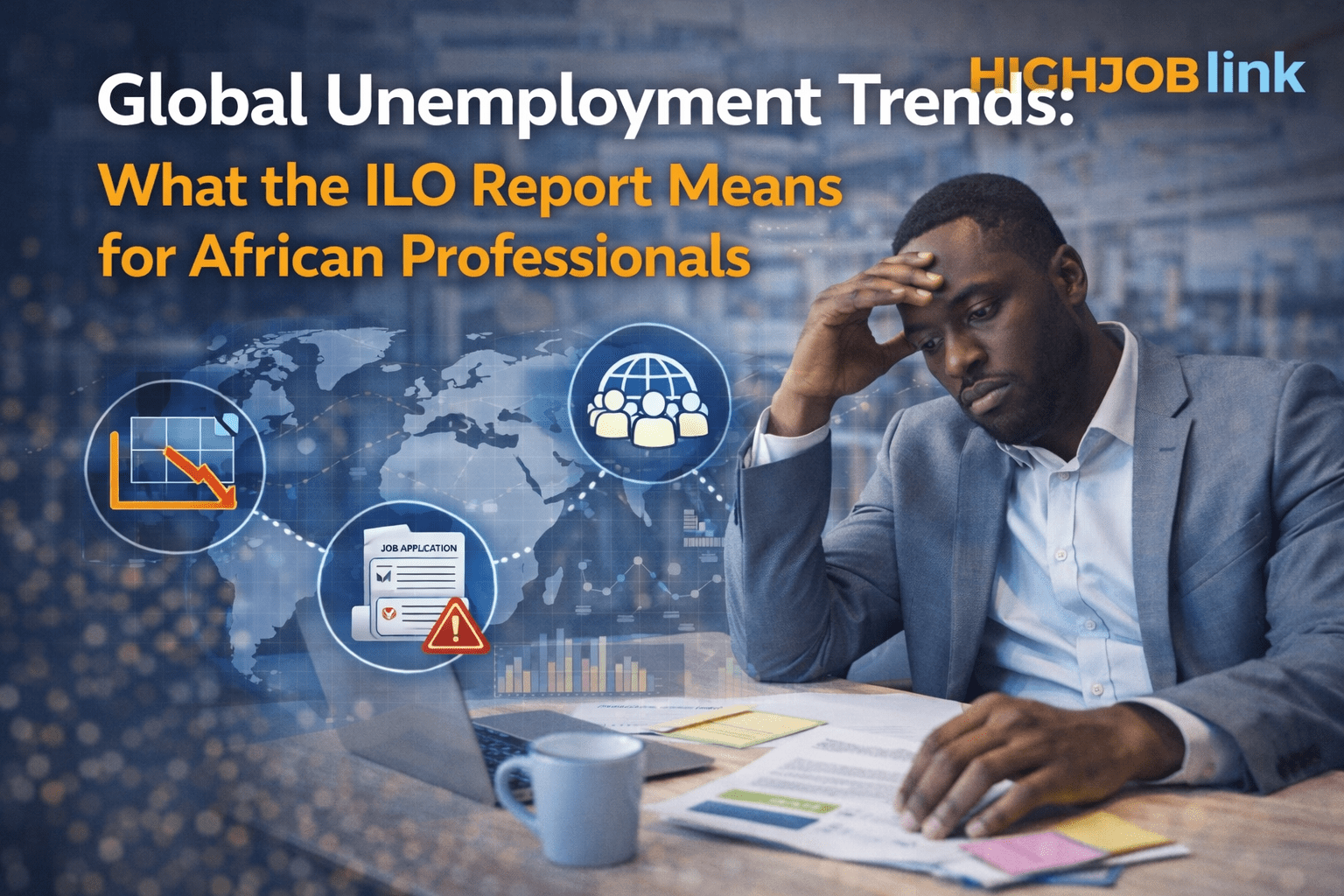
Global Unemployment Trends 2026 suggest that while the world looks stable on paper, African professionals are facing a much more complex reality. I’ve spent the morning pouring over the latest International Labour Organization (ILO) flagship report, Employment and Social Trends 2026, and honestly? The numbers tell two very different stories. As someone who tracks the heartbeat of the African labor market every day, I can tell you that “stable” is a dangerous word. It masks the struggle for quality jobs that we see on the streets of Lagos and in the tech hubs of Nairobi.
When the ILO Report 2026 dropped, it projected a global unemployment rate of 4.9%. At first glance, that sounds like a win. But as I dug deeper into the Global Unemployment Trends 2026, I realized that for us in Africa, the “Jobs Gap” is the real metric to watch. It’s not just about who doesn’t have a job; it’s about who has a job that barely keeps them above the poverty line.
From my perspective, the world is leaning on a glass crutch. The report mentions that global unemployment will hold steady, but this is largely due to aging populations in Europe and North America creating labor shortages. In contrast, our continent is younger than ever. While the West is worrying about who will fill their offices, we are worrying about where to build ours.
The Global Unemployment Trends 2026 highlight a widening gap between low-income countries and the rest of the world. For an African professional, this means that even though our local economies might be growing at 3.1%, the quality of that growth isn’t translating into formal, secure “decent work.” We are still heavily reliant on the informal sector, where 9 out of 10 workers in Sub-Saharan Africa currently operate.
One part of the report that really hit home for me was the section on youth. The global youth unemployment rate has ticked up to 12.4%. But the real “shocker” is the NEET rate (those Not in Education, Employment, or Training). In low-income countries, which includes much of our region, that number is a staggering 27.9%.
I see this every day. Brilliant graduates with certificates in hand, yet the African labor market insights suggest they are “overqualified for the informal sector but under-connected for the formal one.” The ILO warns that this isn’t just a temporary phase; it’s a risk to our “demographic dividend.” If we don’t create 200 million quality jobs by 2030, our youth population becomes a social pressure cooker rather than an economic engine.
The report is quite vocal about Artificial Intelligence. I’ve noticed a lot of fear-mongering lately, but the Global Unemployment Trends 2026 offer a nuanced take. In high-income countries, AI is a threat to white-collar jobs. In Africa, the threat is different: Access.
If we don’t bridge the digital divide, we won’t just lose jobs to AI; we’ll lose the ability to compete for the global remote jobs that currently pay in Dollars and Euros. The report suggests that “service-linked trade” is our greatest opportunity. For the first time, the services sector is projected to employ more young Africans than agriculture by the mid-2030s. That’s a massive shift in our economic DNA.
I’ve stopped telling people to just “find a job.” In 2026, we have to find quality. The ILO notes that 2.1 billion people globally are trapped in informal work without social protection. In our context, this looks like the “gig economy” without the safety net.
The Global Unemployment Trends 2026 indicate that real wages are still recovering from the inflation shocks of the previous years. For the African professional, this means that even if you have a job, your purchasing power might be lower than it was five years ago. This is why “side hustles” aren’t just a trend in Nigeria; they are a necessary economic survival strategy.
So, what do we do with this information? Based on my analysis of the Global Unemployment Trends 2026, here is my advice for navigating the year ahead:
Pivot to Services: The Mastercard Foundation Youth Outlook confirms that the services sector (Tech, Finance, Creative) is where the formal, high-paying jobs are moving.
Upskill for Trade-Linked Roles: Almost half of global trade-linked jobs are now in services. If you can provide a service (Accounting, Coding, Digital Marketing) that a company in Europe or Asia needs, you are no longer limited by the local unemployment rate.
Demand Social Protection: As we move into more informal and hybrid roles, we need to be more proactive about our own insurance, pension, and “health security” rather than waiting for a corporate employer to provide it.
The Global Unemployment Trends 2026 might look stable in a Geneva boardroom, but on the ground in Africa, they are a call to action. We cannot rely on global stability to fix our local “jobs gap.” We have to lean into the digital services economy and ensure that our growth is inclusive of the millions of young people entering the market every month.
At HighJobLink, I’m committed to helping you stay ahead of these trends. Don’t just look at the unemployment rate; look at your own market value. The world is changing, and while the “stable” 4.9% might not tell the whole story, your ability to adapt will be the most important chapter.