Physical Address
34 Ire-Akari Estate Road, Isaga Tedo, Lagos, Nigeria
Physical Address
34 Ire-Akari Estate Road, Isaga Tedo, Lagos, Nigeria
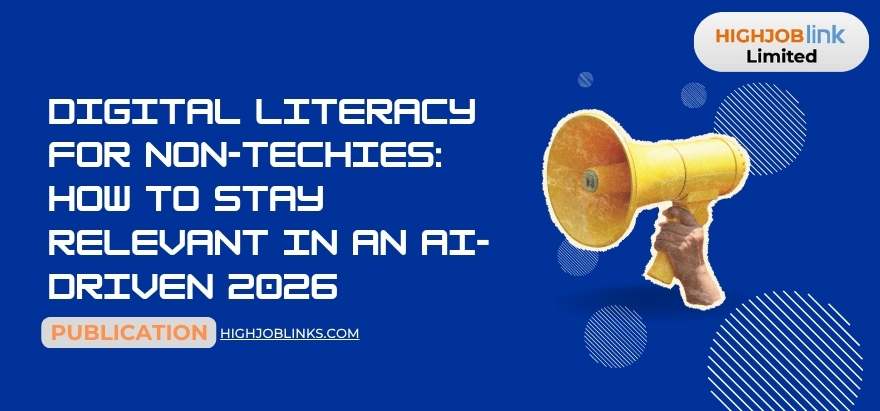
Developing strong digital literacy for non-techies is the most vital step you can take today. I remember a time, not so long ago, when “digital literacy” simply meant knowing how to attach a PDF to an email or maybe navigating a basic Excel spreadsheet. Those days are gone. As we look toward the landscape of 2026, the definition of being “literate” in the workplace has shifted from basic operation to strategic collaboration with intelligent systems.
I’ve sat through countless meetings where my colleagues, brilliant people in marketing, human resources, and administration, looked visibly shaken by the mention of “automated workflows” or “generative data models.” If that’s you, I want you to take a deep breath. You don’t need to learn how to write Python code to survive. You do, however, need to understand how the digital ecosystem breathes.
The year 2026 isn’t coming; it’s already here in spirit. We are living in an AI-driven job market 2026 where the barrier to entry for many tasks has dropped, but the bar for quality has skyrocketed. For a non-techie, digital literacy now means having the “technological intuition” to know which tool to use and why. It’s about moving from a state of being “tech-terrified” to “tech-enabled.”
When we discuss digital literacy for non-techies, we are really talking about curiosity. In my own journey, I realized that the moment I stopped saying “I’m not a tech person” was the moment my career trajectory changed. That single sentence is a self-imposed ceiling. In a world shaped by Forbes’ insights on digital transformation, staying relevant requires you to dismantle that ceiling and replace it with a skylight.
There is a massive misconception that AI is going to replace every job. In reality, AI is going to replace the people who refuse to use it. This is why digital literacy for non-techies is actually a competitive advantage. If you can pair your “human” skills—empathy, complex negotiation, and ethical judgment, with a solid understanding of digital tools, you become an unstoppable force in the office.
Think of it this way: a calculator didn’t replace the mathematician; it allowed the mathematician to solve bigger problems. Similarly, tech skills for non-technical roles are your modern-day calculator. Whether you are in sales or social work, understanding how data flows through your organization allows you to make better decisions. You aren’t competing with the machine; you are leveraging it to amplify your own human brilliance.
We are currently navigating a significant shift in the future of work readiness. By 2026, most routine administrative tasks will be handled by autonomous agents. This might sound scary, but it’s actually a liberation. It means you get to spend more time on the parts of your job that you actually enjoy. However, this liberation comes with a price: you must be able to manage the systems that are doing the routine work.
Enhancing your digital literacy for non-techies involves learning the “language of logic.” You don’t need to build the software, but you do need to be able to tell the software exactly what you need. This is often called “prompt engineering” or “instructional design,” and it is a skill rooted in clear communication, something non-techies are often better at than the coders themselves!
I often hear people complain that they “missed the boat” on technology. That’s nonsense. The tools being released today are more “human” than ever. We are moving toward “Natural Language Processing,” which means the way you talk to your computer in 2026 will be very similar to how you talk to a coworker. This is the ultimate win for digital literacy for non-techies.
To maintain your future of work readiness, focus on these three pillars:
Data Comfort: You don’t need to be a data scientist, but you should be able to look at a dashboard and understand what the “story” is.
Tool Agility: Stop getting attached to specific software. Be ready to switch from one platform to another when a better one emerges.
Security Awareness: Understanding the basics of digital safety and ethics is no longer optional; it is a core part of your professional responsibility.
The concept of “schooling” is being replaced by “learning.” If you want to master digital literacy for non-techies, you have to adopt a permanent “student” mindset. I spend at least thirty minutes every morning looking at new tools or reading about industry shifts. It’s not a chore; it’s an investment in my own market value.
LinkedIn Learning and similar platforms are overflowing with resources specifically designed for people who don’t have a computer science degree. The key is to start small. Don’t try to learn everything at once. Pick one digital bottleneck in your current daily routine and find a tool to solve it. That is the essence of surviving the AI revolution.
Let’s be real: change is exhausting. The constant notifications and the “new version available” pop-ups can feel overwhelming. Part of digital literacy for non-techies is learning how to manage “tech-fatigue.” You have to be the master of your devices, not the slave.
Developing a personalized digital workflow that works for your brain is essential. For some, that means high-octane automation. For others, it means using digital tools to carve out more “analog” time for deep thinking. There is no one-size-fits-all approach to surviving the AI revolution, and that’s the beauty of it. You get to define what “literate” looks like for your specific career path.
As we approach the mid-point of the decade, the gap between the “tech-enabled” and the “tech-resistant” will widen into a canyon. By focusing on digital literacy for non-techies, you are building a bridge across that canyon. You are ensuring that your experience, your wisdom, and your unique perspective aren’t lost in the digital noise.
I’ve watched veterans in the industry reinvent themselves simply by embracing a few new digital habits. It’s inspiring to see. It proves that tech skills for non-technical roles aren’t about age or background; they are about attitude. If you are willing to be a “beginner” again, you will never be obsolete.
The journey toward total digital literacy for non-techies is not a race; it’s a marathon that never truly ends. But the rewards are incredible. You will find yourself working faster, thinking clearer, and feeling more confident in your professional skin.
In an AI-driven job market 2026, your most valuable asset is your ability to learn, unlearn, and relearn. Don’t fear the machines. Don’t fear the algorithms. Embrace the tools, master the basics, and keep your human heart at the center of everything you do. If you can do that, you won’t just stay relevant; you will lead the way into the future.