Physical Address
34 Ire-Akari Estate Road, Isaga Tedo, Lagos, Nigeria
Physical Address
34 Ire-Akari Estate Road, Isaga Tedo, Lagos, Nigeria

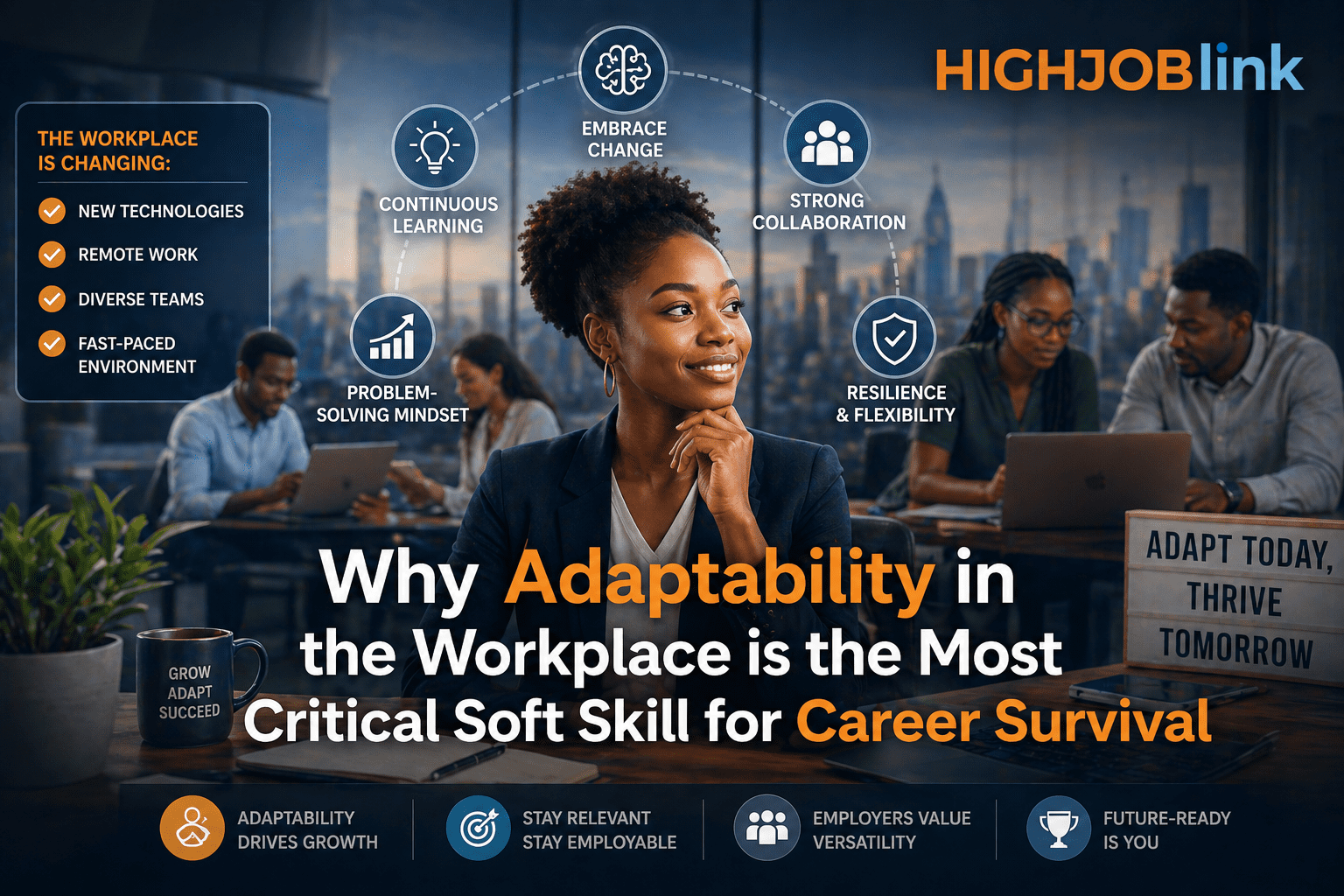
Adaptability in the workplace 2026 is no longer just a “nice-to-have” trait; it is the absolute bedrock of professional existence. As I look at the current landscape of our industry, I see a world that is vibrating with change. If you aren’t ready to bend, you are going to snap. We have moved past the era where a degree or a specific technical certification could carry you for a decade. Today, the “half-life” of skills is shrinking faster than a cheap sweater in a hot dryer. To stay relevant, you need to be a professional chameleon.
The global market has undergone a radical transformation. We aren’t just talking about remote work or hybrid offices anymore. We are talking about a fundamental restructuring of how value is created. According to recent reports from the World Economic Forum, analytical thinking remains huge, but the capacity to pivot is what actually saves your paycheck when the bots move in on your routine tasks.
When I talk about adaptability in the workplace 2026, I’m referring to the psychological and practical agility required to handle the “AI Reality Gap.” While machines handle the data-crunching, humans must handle the context. If your job description today looks exactly like it did eighteen months ago, you’re likely standing on a melting iceberg. The most successful people I know are those who treat their career like a software update, always in “beta,” always refining, and never static.
Let’s be brutally honest: your hard skills are decaying. It sounds harsh, but it’s the truth I see every day in the high-stakes job market. Research suggests that technical knowledge now has a lifespan of about five years. This means half of what you learned in 2021 is effectively obsolete today. This is why adaptability in the workplace 2026 is the only insurance policy you actually own.
In an AI-driven job market, the tools change every Tuesday. One week we are mastering generative prompts; the next, we are integrating autonomous agents into our workflows. If you are the person who sighs every time a new system is introduced, you are signaling to your leadership that you are a legacy asset. You want to be a growth asset. High-value professionals in 2026 are those who lean into the discomfort of the “new” without needing a three-month transition period.
There is a fascinating, if slightly terrifying, phenomenon happening right now called the Adaptability Paradox. Most workers know they need to evolve, but they have no idea what they are evolving for. It’s like running a marathon where the finish line keeps moving and sometimes turns into a swimming pool.
To thrive, you must master these future of work skills:
Unlearning: The ability to let go of “how we’ve always done it.”
Cognitive Flexibility: Switching between different concepts or multiple tasks simultaneously without losing your mind.
Proactive Upskilling: Identifying a gap before your boss does.
I’ve noticed that the people struggling the most are those with “fixed mindsets”—the ones who believe their intelligence and talents are static. On the flip side, the “Adaptive Thrivers” are the ones who see a massive industry disruption and think, “Great, how can I use this to my advantage?”
You don’t just wake up one day and become adaptable. It’s a muscle. If you want to strengthen your adaptability in the workplace 2026, you need to put yourself in “controlled danger” zones. Volunteer for the project that confuses you. Work with the department that speaks a different professional language.
I always tell my peers that if you are the smartest person in the room, you are in the wrong room for your career survival. You should be seeking out environments that force you to recalibrate your internal compass. This kind of soft skills for career growth is what differentiates a manager from a leader. Leaders don’t just survive change; they architect it.
You cannot be adaptable if you are emotionally brittle. When things change, our first instinct is often fear or defensiveness. “Will I lose my job?” “Is my expertise still valid?” These are valid feelings, but they shouldn’t be the driver of your actions. Adaptability in the workplace 2026 requires a high level of EQ to manage the stress of constant transition.
By staying calm when the roadmap gets thrown out the window, you become the anchor for your team. This is a massive “personal brand” win. When leadership looks for who to promote, they aren’t just looking at the person who hit their KPIs; they are looking for the person who kept their cool and found a new path when the old one was blocked by a sudden market shift or a new AI integration.
We often talk about reskilling for 2026 as if it’s a chore, like doing your taxes. In reality, it’s the most vibrant part of a modern career. Learning a new skill should feel like gaining a superpower. Whether it’s data storytelling, ethical AI management, or sustainable business practices, every new capability you add makes you more “un-fireable.”
I’ve seen brilliant engineers get sidelined because they refused to learn the “human” side of their work, and I’ve seen junior associates skyrocket to leadership because they were incredibly quick to adopt new collaborative platforms. The common denominator is always adaptability in the workplace 2026. It bridges the gap between what you used to do and what the world now needs you to do.
The old saying was “survival of the fittest,” but in the modern economy, it’s survival of the most flexible. Your career is no longer a ladder; it’s a jungle gym. Sometimes you have to move sideways, or even down a rung, to get to a better position on a different structure.
If you want to ensure your adaptability in the workplace 2026 is top-tier, start by auditing your daily habits. Are you seeking out new information? Are you comfortable being a beginner? If the answer is no, it’s time to shake things up. The future belongs to the learners, not the “knowers.”
As we move deeper into this year, the pressure to perform will only increase. But don’t let that intimidate you. Use it as fuel. The fact that you are even reading about adaptability in the workplace 2026 puts you ahead of a significant portion of the workforce who are still trying to ignore the writing on the wall.
Stay curious, stay humble, and most importantly, stay agile. Your career isn’t a destination; it’s a journey of continuous reinvention. If you can master the art of the pivot, you won’t just survive 2026—you will own it.