Physical Address
34 Ire-Akari Estate Road, Isaga Tedo, Lagos, Nigeria
Physical Address
34 Ire-Akari Estate Road, Isaga Tedo, Lagos, Nigeria


Nigeria's 2026 job market favors tech, renewable energy, agribusiness, and creative roles — here's which industries are hiring and what they pay.
Nigeria’s 2026 labor market is moving quickly. The key sectors hiring even two years ago do not resemble today’s hiring pool; between increased foreign investments in technology, a growing green energy market and an maturing creative economy, knowing where the current job demand lies is key-from job applicants to career changers and current NYSC cohorts.
Nigeria’s formal labor market in 2026 shows a familiar tension: headline unemployment remains relatively low, but underemployment and informality stay high, and demand is heavily concentrated in a handful of sectors and regions. The Nigerian Institute of Social and Economic Research (NISER) reported that its Q1 2026 analysis of nearly 800 advertised vacancies found the service sector dominating formal job postings, with vacancies concentrated heavily in the South West and persistent shortages of entry-level graduate roles. For a broader read on how this fits global trends, see our Global Unemployment Trends 2026 breakdown of the ILO’s latest report.
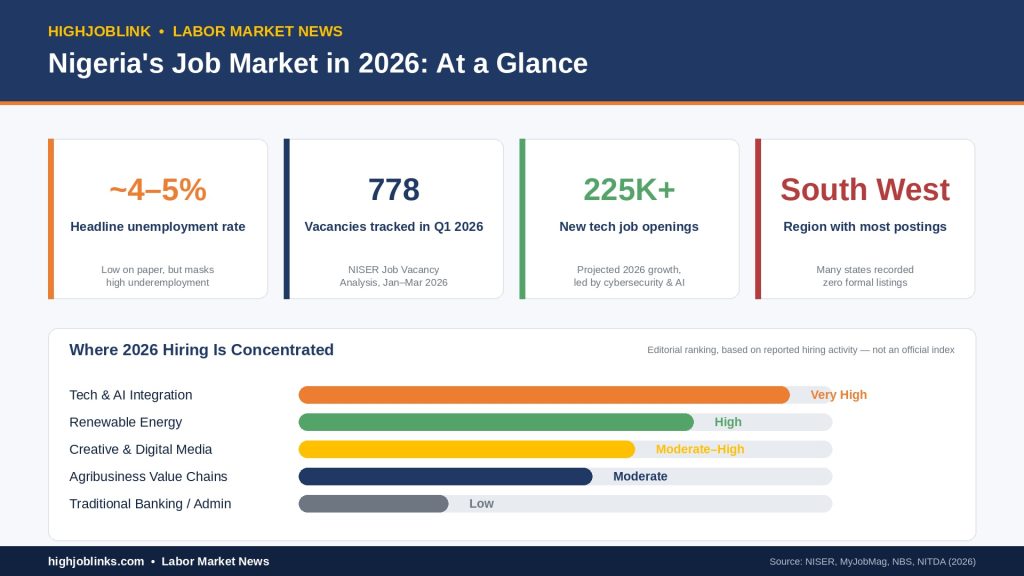
Tech remains Nigeria’s most active hiring sector, but the roles in demand have shifted. Where full-stack development dominated listings a couple of years ago, 2026 postings are increasingly weighted toward AI integration and cybersecurity. Nigeria’s tech sector is projected to generate roughly 225,000 new job openings, with cybersecurity a particular bottleneck as demand continues to outpace the supply of trained professionals. The National Information Technology Development Agency (NITDA) has continued pushing national digital-literacy targets, which is accelerating hiring for roles that bridge legacy business operations with automation and AI tooling. For a deeper dive into which specific tech roles are holding up best, see our Tech Sector Outlook 2026, and if you’re weighing whether entry-level tech roles are still viable, our piece on AI vs. Entry-Level Jobs is worth reading alongside this one.
As Nigeria’s national grid continues decentralizing, solar energy firms, hydroelectric maintenance companies, and grid-analytics providers have become significant employers — particularly for engineering graduates and NYSC corps members with technical backgrounds. Roles to watch include solar installation engineers, grid analytics specialists, and project managers for renewable infrastructure. We cover this sector in more depth, including which roles are growing fastest, in Green Energy Careers: The Fastest Growing Employment Sector in Nigeria for 2026.
Nigeria’s creative exports — Afrobeats, Nollywood, and digital content — have matured into a structured, revenue-generating sector rather than a collection of side hustles. According to the National Bureau of Statistics (NBS), the creative and digital economy is an increasingly significant contributor to youth employment. Hiring has become more technical, with real demand for content strategists, digital rights specialists, and talent managers, not just performers and creators themselves.
Agri-jobs are no longer just on the farm and they are spilling into value chains – which present stronger demand. Strongest is for Agri-logistics and Food processing technologies as the nation continues to push for export standard processing and viable cold-chain logistics to meetfood security objectives.
A few structural shifts are shaping hiring behavior across all of these sectors:
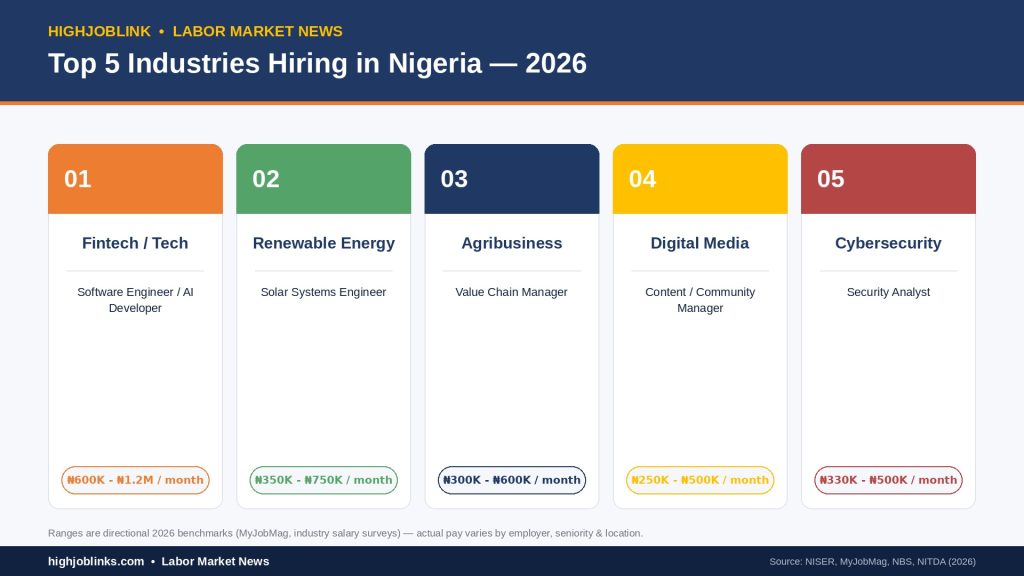
Compensation varies significantly by employer, but recent industry salary surveys give a useful benchmark. MyJobMag’s 2026 salary data puts broad monthly averages across surveyed roles at roughly ₦200,000–₦600,000, with fintech, oil and gas, and specialized tech roles at the top of the range. Cybersecurity entry-level salaries have been reported in the ₦330,000–₦500,000/month range, while data science roles can average significantly higher depending on seniority. If you’re evaluating an offer against the broader wage picture, our Nigeria’s New Minimum Wage & Private Sector Salaries: 2026 Reality Check is a useful companion read.
| Industry | In-Demand Role | Typical Monthly Range* |
|---|---|---|
| Fintech / Tech | Software Engineer / AI Developer | ₦600,000 – ₦1,200,000 |
| Renewable Energy | Solar Systems Engineer | ₦350,000 – ₦750,000 |
| Agribusiness | Value Chain Manager | ₦300,000 – ₦600,000 |
| Digital Media | Content / Community Manager | ₦250,000 – ₦500,000 |
| Cybersecurity | Security Analyst | ₦330,000 – ₦500,000 |
*Ranges are directional estimates drawn from published 2026 salary surveys (MyJobMag, industry reporting) and vary by employer, seniority, and location. Treat as a starting benchmark, not a guarantee.
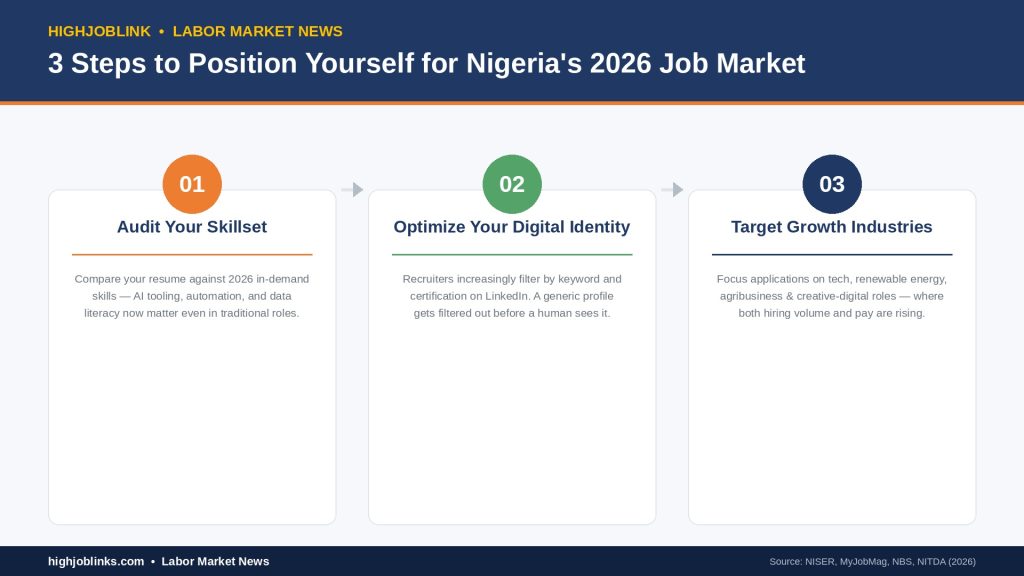
While job growth won’t be everywhere in Nigeria in 2026 – the Nigerian job market will be uneven in growth – job growth in banking administration plateau; it will be growing in tech, green energy agribusiness value chain; it will be growing in the creative economy; and these other value chains that are not your typical banks. So what does this mean for the individual looking for a job, the same thing that is evident through all this evolution and disruption of business – how aligned your skill-set is to wherever growth exists, is more important than your paper qualifications.