Physical Address
34 Ire-Akari Estate Road, Isaga Tedo, Lagos, Nigeria
Physical Address
34 Ire-Akari Estate Road, Isaga Tedo, Lagos, Nigeria


A new-collar worker builds a tech career through skills and certifications, not a degree — here's how AI is accelerating that shift.
A new-collar worker is an individual who earned a career in a technically complex, high-paying job – in fields like cybersecurity, AI or cloud computing – by attending through certification programs, gaining on-the-job training, or simply teaching themselves the skills, rather than relying on a four-year degree. It’s not just a new marketing buzzword: IBM’s ex-CEO Ginni Rometty actually first coined the term in 2016, but it’s become all the more significant in 2026 as AI upended which skillsets companies actually seek.
“New-collar” was a tongue-in-cheek twist on blue-collar and white-collar professions; it refers to middle-skill technology jobs like cybersecurity analysts, application developers, or cloud experts – where the skills are learned through training but a degree isn’t essential. IBM popularized the idea based on one easy insight: some high-demand technical skills evolve more quickly than university programs, making training and certification a better measure of capability.
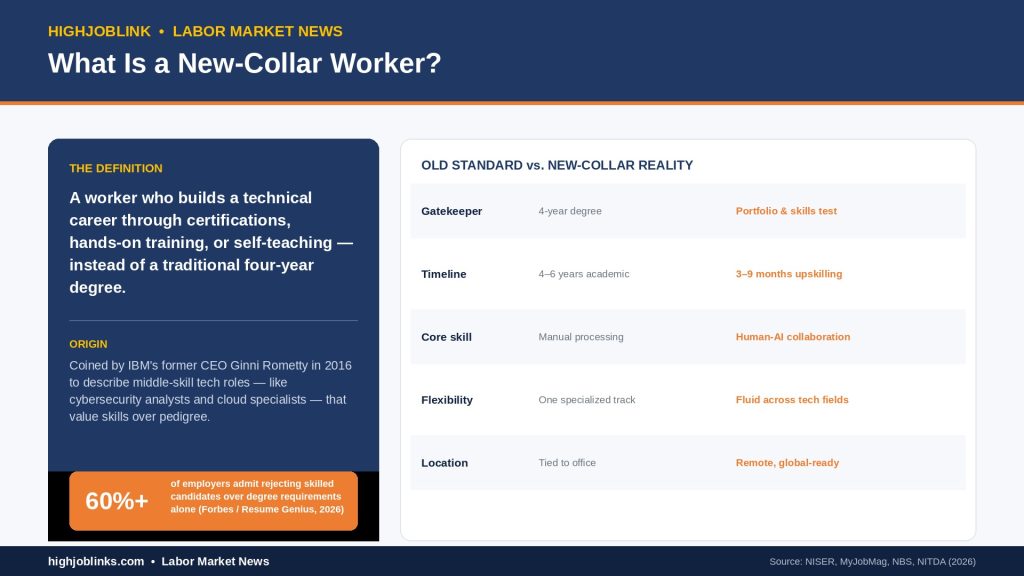
That trend has only increased. A new review from Forbes of the 2026 New-Collar Jobs Report by Resume Genius, revealed that more than 60% of employers had turned down candidates with the skillsets and experience for the position because they didn’t have a college degree – a trend that more companies are now pushing to fix as they compete for this limited talent.
Generative AI tools didn’t just generate new jobs – they could accelerate the path to real value in a technical job. It takes years for a university to add new courses and develop new programs; a motivated person can acquire meaningful, tangible experience with a certain AI solution in a matter of months. That mismatch is the primary reason new-collar hiring has graduated from an IBM experiment to a Microsoft-wide practice.
It’s also transforming the actual nature of work. No one needs to pluck out raw code the way they once did, when AI is going to do most of that work for you. What’s emerging as the scarcity is judgment-how you question, correct, and guide the output of these systems. That is paving the way for tech work to be done by those who’ve never studied computer science-a trend covered in our piece on Entry-Level Jobs in AI.
| Career Characteristic | Traditional White-Collar Role | New-Collar AI Role |
|---|---|---|
| Primary Gatekeeper | Four-year university degree | Portfolios and skills tests |
| Learning Timeline | 4–6 years of academic theory | 3–9 months of focused upskilling |
| Core Daily Competency | Manual data processing | Human-AI collaboration |
| Industry Agility | Locked into one specialized track | Fluid across tech fields |
| Geographic Flexibility | Tied to physical offices | Open to remote, global work |
For professionals in Lagos, Abuja, and other major hubs, this shift matters more than it might elsewhere. According to the National Bureau of Statistics, Nigeria’s formal job market continues to struggle with entry-level absorption, which makes remote-friendly, skills-based technical work an increasingly practical path — not just for those trying to relocate abroad, but for people who want to earn competitively while staying local. Our Nigeria Job Market Report 2026 covers which sectors are actually hiring right now if you’re weighing where to focus your upskilling.
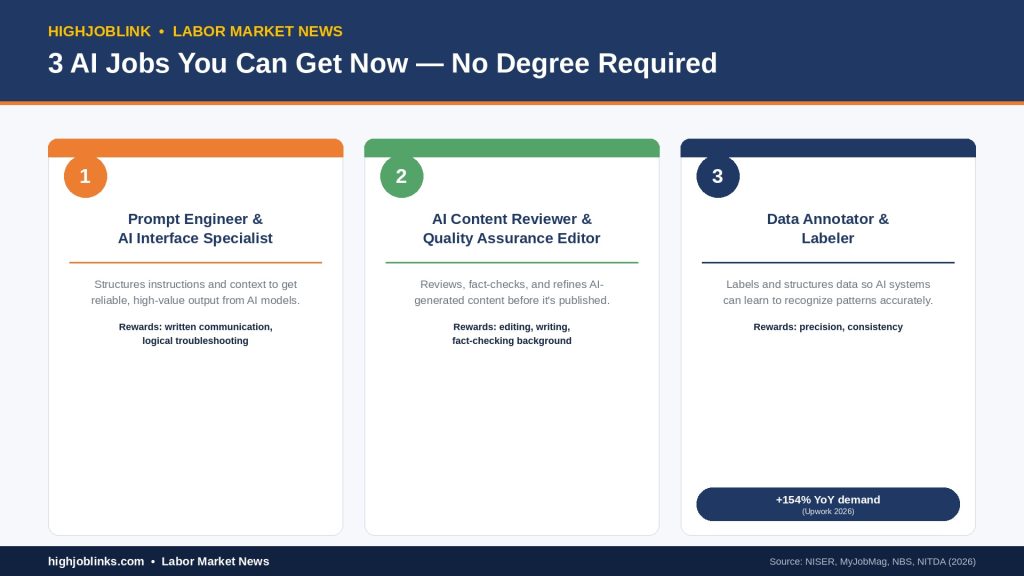
Prompt Engineers and AI Interface Specialists. What is this? Not so much this role is about figuring out how to build instructions, context, and constraints that will produce a safe, valuable output from an AI model. It may favour lots of good writing and well-reasoned troubleshooting more than formal technical training.
AI Content Reviewers and Quality Assurance Editors. AI produces information quickly but still struggles with inaccuracies, contradictions, and bland language. Employers require writers, editors or researchers to input information into AI for fact-checking or editing before deployment.
Data Annotators and Labelers. You first need to “teach” an AI to identify a pattern by providing well-annotated data. The demand for this work has seen exponential growth: Upwork’s 2026 In-Demand Skills report revealed that the demand for AI data annotation and labeling grew 154% since 2016, making it one of the fastest-growing skill categories in the report. It also requires less specialized training to get started, as it’s more about being accurate and consistent than anything else.
For a broader look at which technical skills are commanding the strongest demand and pay right now, see our Tech Sector Outlook 2026.
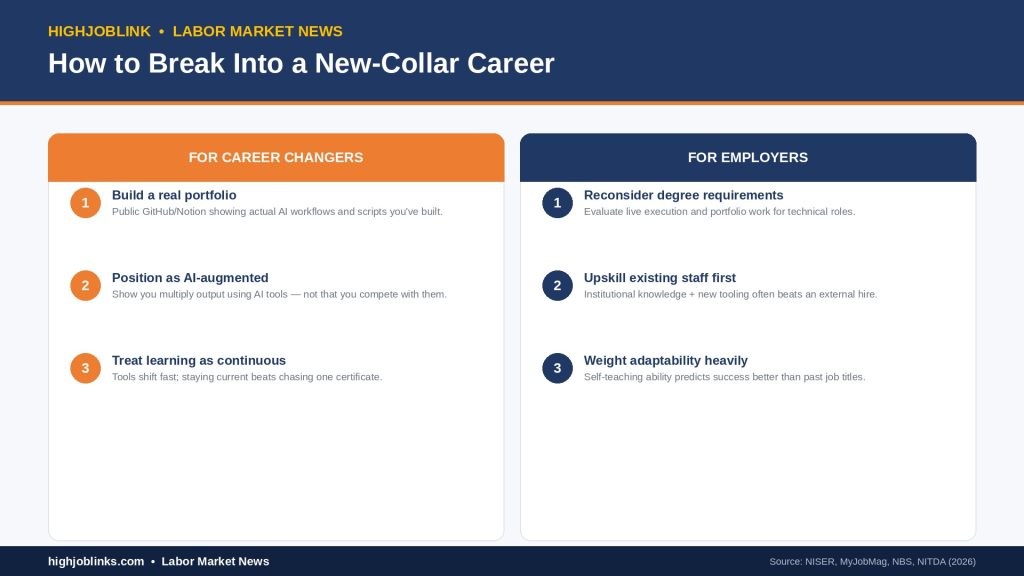
If you’re changing careers:
If you’re hiring:
The traditional rules of career-making – a degree, a steady job title, a clear track – won’t vanish overnight, but they’re no longer the only way into lucrative, technical roles. For anyone who struggled to find their way through the traditional tech pipeline, the new-collar revolution is a real-world route: it prioritises demonstrated ability and a learning mindset over formal qualifications. As important context, in case you’re interested in how global labour markets are navigating the very same shifts, you might also want to check out our Global Unemployment Trends 2026 analysis of the ILO’s latest report, which complements this one.