Physical Address
34 Ire-Akari Estate Road, Isaga Tedo, Lagos, Nigeria
Physical Address
34 Ire-Akari Estate Road, Isaga Tedo, Lagos, Nigeria

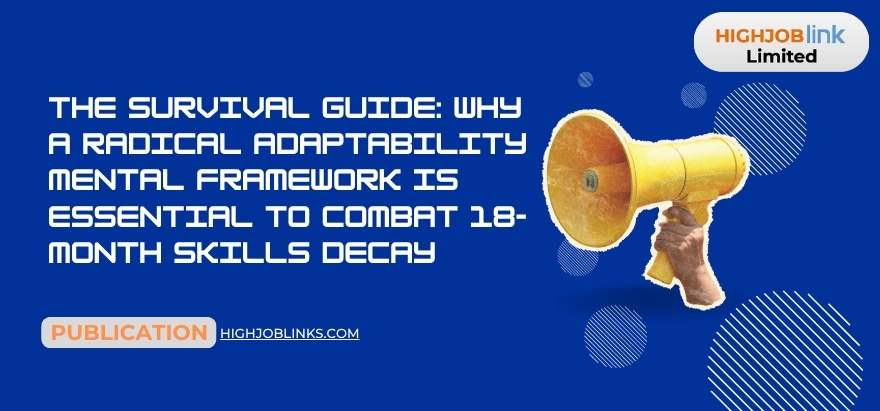
Adopting a radical adaptability mental framework is the only way to stay relevant today. I have watched the professional landscape shift from a steady climb to a frantic scramble, and it is honestly exhausting if you aren’t prepared. We used to talk about lifelong careers, but now we are lucky if our specific technical expertise lasts through the next fiscal year. The reality of an industry-wide skills decay hitting every eighteen months means that what you know is far less important than how fast you can let it go.
I often think back to the early days of my career when a single certification felt like a golden ticket. Now, I see those same certifications becoming digital paperweights. If you are feeling that familiar sting of obsolescence, you aren’t alone. It is a shared, somewhat terrifying experience that defines our modern era. To thrive, you have to stop viewing your knowledge as a fortress and start viewing it as a fluid, ever-changing stream.
We are living in an era where the shelf life of a professional skill has dropped to roughly five years, with technical niches seeing an industry-wide skills decay every eighteen months. This isn’t just a trend; it is a fundamental restructuring of how value is created and lost. In my own work, I’ve noticed that tools I mastered just two years ago are now being handled by basic automation scripts.
When you operate within a radical adaptability mental framework, you accept that your current “expert” status is temporary. This is a difficult pill to swallow for many high achievers. We take pride in what we know. However, the World Economic Forum has repeatedly highlighted that the capacity to pivot is what actually protects your income when routine tasks are automated. You must be willing to be a beginner over and over again.
I truly believe that a radical adaptability mental framework is the best insurance policy you can hold. Traditional job security is a myth in a world where entire departments can be redesigned by a single AI implementation. I’ve seen incredibly talented friends lose their footing because they were too attached to their “proven” methods. They had the IQ, but they lacked the cognitive flexibility to bend when the wind changed.
In a competitive market, having professional survival 2026 skills means being a “growth asset” rather than a “legacy asset”. Legacy assets are those who resist new systems because they are comfortable with the old ones. Growth assets are those who lean into the discomfort of the new. Every time a new system is introduced, I make it a point to be the first one to break it, learn it, and then teach it. That is how you stay indispensable.
Building this framework isn’t an overnight task; it is a daily practice. From my perspective, it requires three main shifts in how you view your daily work:
Intentional Unlearning: You must have the courage to let go of “how we have always done it”. This is often the hardest part because our identity is tied to our old ways of working.
Proactive Upskilling: Don’t wait for your company to offer a training session. Identify the gaps in your industry before they become canyons.
Stress Tolerance: You have to manage the “AI Reality Gap” without losing your mind. This means staying calm when the roadmap is thrown out the window.
When I talk about cognitive flexibility at work, I’m talking about the mental agility to switch between different concepts without a massive drop in productivity. It is about being “beta” all the time, always refining, always updating, and never reaching a final, static version of yourself.
The pressure to reinvent yourself every eighteen months is immense. I’ve had many late-night conversations with peers who feel like they are on a treadmill that keeps speeding up. The only way to survive without burning out is to find joy in the learning process itself. If you view a radical adaptability mental framework as a burden, you will eventually collapse. If you view it as a way to stay curious and engaged, it becomes a superpower.
We are seeing a rise in “new-collar” roles that blend traditional human strengths with advanced technical orchestration. These roles didn’t exist two years ago, and they might look completely different two years from now. This is the essence of high-income career skills in 2026. You aren’t being paid for what you already know; you are being paid for how quickly you can learn the next thing.
You cannot have a radical adaptability mental framework if you are emotionally brittle. When change happens, the first instinct is often fear or defensiveness. I’ve felt it myself, that sudden panic when a new piece of technology threatens to make a skill I spent years perfecting irrelevant. But you cannot let that fear drive your actions.
According to Forbes, digital transformation is as much about people as it is about technology. High-value professionals use their EQ to manage the stress of constant transition. By staying calm and finding a new path when the old one is blocked by a sudden market shift, you become the anchor for your team. This is a massive win for your personal brand.
It is one thing to survive a shift, but it is another thing entirely to own it. Those who master a radical adaptability mental framework don’t just react to change; they architect it. They are the ones looking at the industry-wide skills decay and seeing an opportunity to leapfrog over their competitors who are still clinging to the past.
I always tell my colleagues that if you are the smartest person in the room, you are in the wrong room. You should seek out environments that force you to recalibrate your internal compass. This is how you develop professional survival 2026 capabilities. You have to put yourself in “controlled danger” zones where you are forced to use new tools and think in new ways.
The old saying was “survival of the fittest,” but in our modern economy, it is survival of the most flexible. Your career is no longer a ladder; it is a jungle gym. Sometimes you have to move sideways, or even down, to get to a better position on a different structure. This requires a total lack of ego.
A radical adaptability mental framework allows you to move through these transitions with grace. You stop seeing a career change as a failure and start seeing it as a necessary evolution. Every new skill you add, whether it is data storytelling or ethical AI management, makes you more “un-fireable”.
As we move deeper into this year, the speed of change is only going to increase. Don’t let that intimidate you. Instead, let it fuel your curiosity. The fact that you are even thinking about a radical adaptability mental framework puts you miles ahead of those who are still trying to ignore the writing on the wall.
Stay humble, stay agile, and remember that your career isn’t a destination, it is a journey of continuous reinvention. If you can master the art of the pivot and embrace the reality of industry-wide skills decay, you won’t just survive 2026. You will own it.