What Is a New-Collar Worker? AI Jobs You Can Get Now

When defining exactly what is a new-collar worker? AI jobs you can get now represent the ultimate golden ticket for anyone looking to reinvent themselves in this digital era. I have spent a significant amount of time recently tracking international hiring data, reviewing updates from major technology organizations, and evaluating how progressive startups are structuring their teams. What I discovered is that the old-school requirement of spending four to six expensive years in a lecture hall to land a high-paying role is completely dying out. Forward-thinking companies care about one thing only: your practical, hands-on ability to use advanced tools to drive tangible business results.

Breaking Down the Concept: Skill Over Schooling

It is no secret that I have been a vocal critic of the traditional higher education pipeline, especially when it comes to rapidly changing industries. For decades, the professional landscape was strictly divided between blue-collar manual labor and white-collar office management. Today, that rigid dichotomy has completely collapsed, giving rise to a completely new class of skilled professionals.

1. The Core Meaning of the New-Collar Revolution

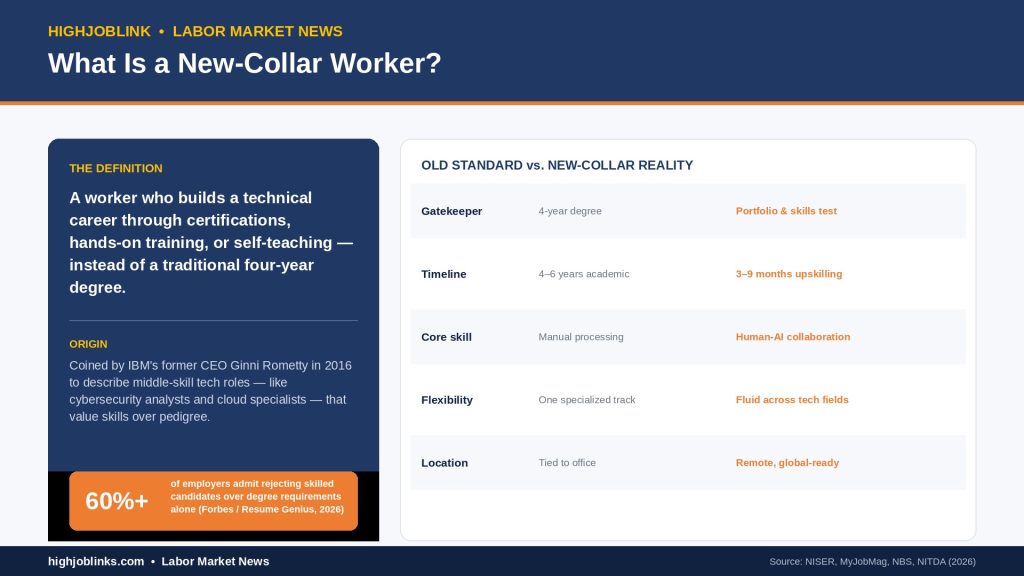
The term “new-collar” refers to high-growth, technically demanding roles that prioritize specialized skills, practical certifications, and vocational adaptability over a traditional four-year university degree. I see this structural transition as an incredible equalizer.

Instead of evaluating your background based on the pedigree of your school, modern employers are testing your capability through practical portfolios, live technical challenges, and specialized bootcamp certificates. This means that if you can demonstrate a deep, operational mastery of modern software interfaces, your formal educational background becomes completely irrelevant.

2. Why the Rapid Rise of Artificial Intelligence Accelerated This Trend

I view the current artificial intelligence boom as the primary catalyst behind the collapse of traditional white-collar requirements. When generative AI applications burst into the mainstream, it completely changed how software development, content creation, and data analysis are executed.

Because these tools are completely new, universities have not had the time to build structured, multi-year degree programs around them. As a result, someone who spends three months intensely teaching themselves how to effectively interact with a specific AI model can easily possess more relevant, up-to-date expertise than a professional who graduated with a computer science degree five years ago.

3. The Shift from Abstract Coding to Human-AI Collaboration

We also need to talk about how the fundamental nature of technical work has evolved. In the past, breaking into the tech sector meant memorizing complex coding syntax and writing endless lines of raw software scripts. Today, advanced AI platforms can handle the heavy lifting of raw code generation in seconds.

According to Forbes, the real professional bottleneck has shifted from writing the code to guiding, auditing, and refining the output of these machine learning models. This requires strong logical thinking, deep curiosity, and clear communication skills, opening up high-paying tech fields to individuals from diverse, non-technical backgrounds.

Tracking the Shift: Old Corporate Standards vs. The New-Collar Reality

To give you a crystal-clear picture of how this professional landscape has been completely reorganized, let us examine how old-school corporate hiring metrics stack up against modern, skill-first requirements.

Career Characteristic Traditional White-Collar Role Evolving New-Collar AI Role
Primary Gatekeeper Four-year university degree Targeted portfolios and skills tests
Learning Timeline 4 to 6 years of academic theory 3 to 9 months of intense upskilling
Core Daily Competency Manual data processing and execution Strategic human-AI collaboration
Industry Agility Locked into a single specialized track Highly fluid across multiple tech fields
Geographic Flexibility Highly dependent on physical offices Extensively open to remote global execution

When we evaluate the reality of what is a new-collar worker? AI jobs you can get now through this comparison, the structural advantages are impossible to ignore. I firmly believe that the current job market belongs to the fast and the adaptable. While traditional professionals are waiting for corporate permission to pivot, proactive individuals are using accessible digital bootcamps to completely reinvent their earning potential in a matter of months.

Localizing the Shift: Navigating the Tech Landscape in Nigeria

To understand how this global tech revolution impacts your daily life on a practical level, we must look closely at our local economic realities. If you are a professional living and working in Lagos, Abuja, or any major hub across the country, you already know that the local job market requires an entirely different survival strategy than what works in Western nations.

I regularly monitor economic labor updates from the National Bureau of Statistics to understand how macroeconomic shifts affect local employment. Given our unique economic climate, relying entirely on traditional corporate structures is a massive gamble, which is why thousands of ambitious individuals are actively seeking alternative tech training programs in Nigeria to bypass the stagnant local corporate ladder entirely.

The reality is that our local economy is dealing with a significant shortage of traditional entry-level roles, making the pursuit of remote-friendly skills more urgent than ever. For those who want to transition into high-paying, international roles without leaving the country, securing a sustainable tech career path for Nigerians has shifted completely from traditional university education to targeted, practical skill acquisition.

By building specialized expertise, you can position yourself directly for lucrative remote AI jobs in Lagos and beyond, allowing you to earn in foreign currency while operating within your local ecosystem. This structural shift has completely transformed how the younger generation approaches wealth creation, turning a passion for in-demand tech skills in Nigeria into a powerful tool for financial independence.

The Top AI Roles You Can Transition Into Right Now

If you want to capitalize on this massive shift, what are the specific, high-paying roles that you can realistically target today without a formal tech background? Here are the most accessible new-collar positions that are currently experiencing a massive shortage of talent globally.

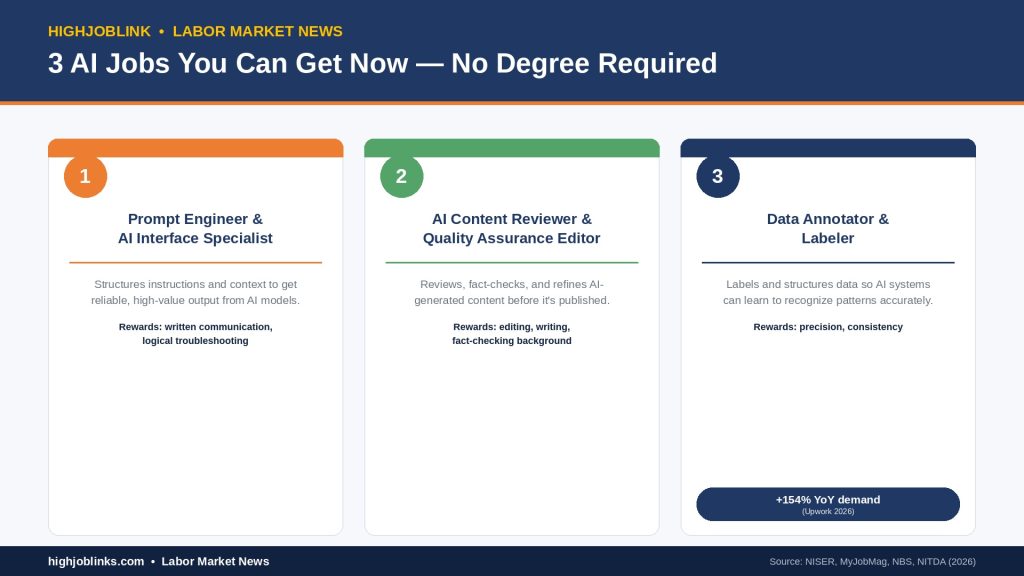
1. Prompt Engineers and AI Interface Specialists

I see prompt engineering as one of the most misunderstood and lucrative entry points into the modern tech ecosystem. A prompt engineer is essentially a professional translator who knows exactly how to structure text commands, parameters, and context to get the most accurate, high-value output from a large language model.

If you possess exceptional communication skills, a deep understanding of human psychology, and a knack for logical troubleshooting, you can easily train yourself to become a top-tier prompt engineer using entirely free, online documentation.

2. AI Content Editors and Quality Assurance Reviewers

According to victoriaindex.com.ng, while generative AI systems are capable of producing millions of words or images in a matter of seconds, they are highly prone to hallucinating facts, introducing logical contradictions, and generating dull, robotic content.

Companies are desperately hiring detail-oriented professionals to review, fact-check, and humanize AI-generated materials before they are published or deployed. If you have a background in writing, editing, or administrative coordination, this is a natural, seamless transition that allows you to work directly alongside cutting-edge systems.

3. Machine Learning Data Annotators and Labelers

Before a complex AI system can recognize an object, detect fraud, or understand human sentiment, it must be trained on massive amounts of clean, organized data. Data annotators are the essential architects who manually tag, categorize, and structure text, images, and video feeds so that machine learning algorithms can learn accurately. This role requires precision and deep consistency rather than complex mathematical training, making it a brilliant, accessible entry point for anybody looking to get their foot in the door of the global tech economy.

My Personal Strategy for Landing a New-Collar Tech Role

If you are ready to stop watching from the sidelines and want to actively secure a modern, high-paying career, how do you handle the core reality of what is a new-collar worker? AI jobs you can get now? Here is my personal step-by-step blueprint to help you transition seamlessly into the future of work.

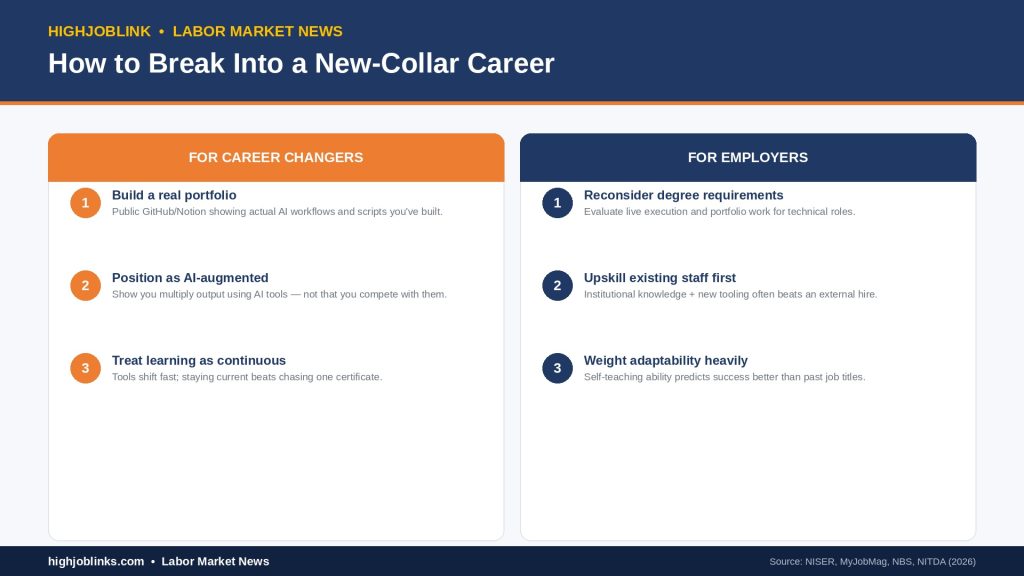
For Ambitious Career Changers

  • Build a Tangible Project Portfolio: Stop putting endless lists of corporate buzzwords on your resume. Instead, build a public portfolio on platforms like GitHub or Notion that explicitly showcases real AI workflows, automated scripts, or prompt libraries you have built from scratch.

  • Master the Art of Human Hybrid Work: Do not position yourself as someone who is trying to compete with technology. Show potential employers that you know how to use automated tools to double or triple your daily output, making you incredibly cost-effective to hire.

  • Commit to Continuous Micro-Learning: The tech landscape changes every single week. Instead of chasing a single, massive credential, set aside thirty minutes every morning to read technical blogs, test new software updates, and stay ahead of emerging trends.

For Forward-Thinking Employers and Business Owners

  • Ditch the Degree Requirements: When hiring for digital roles, remove the requirement for a university degree from your job descriptions. Evaluate candidates purely on their live execution, problem-solving speed, and practical portfolio data.

  • Upskill Your Internal Staff First: Before spending massive amounts of capital trying to recruit external tech stars, give your current, loyal employees access to specialized AI bootcamps to amplify their existing institutional knowledge.

  • Focus Heavily on Adaptability Metrics: When interviewing new talent, prioritize candidates who show high curiosity and a proven track record of teaching themselves new digital systems over those who rely solely on their past credentials.

Closing Thoughts: Reclaiming Your Future in a Changing Economy

At the end of the day, economic transitions are an unavoidable part of human history. The old professional rules that our parents relied on are simply not built to survive the speed of the 2026 digital economy. I believe that true career security never comes from a stable job title or an expensive piece of paper from a university; it comes entirely from your personal willingness to learn, adapt, and provide immense value using the absolute best tools available today.

The massive global movement surrounding what is a new-collar worker? AI jobs you can get now is a magnificent wake-up call for anyone who felt locked out of the traditional corporate structure. It can feel incredibly intimidating to step into the world of tech for the first time, but this unique moment in history has leveled the playing field completely. Focus on building real skills, take control of your learning path, and stay highly proactive. The future of work is being written right now, and you have every tool you need to be the one who writes it.

Updated: May 25, 2026 — 8:07 am

The Author

HighJobLink Limited

HighJobLink Limited is a Lagos-based Nigerian recruitment agency and job search platform founded in 2014. It connects job seekers with employers, providing career guides, job listings, and labor market news. The agency operates as a bridge for recruitment, often featuring job openings and vacancy updates.